News

Jennifer Johnson ’00
 After graduating from BUA in 2000, Jennifer Johnson received her BA in History from Brown University and her PhD in History from Princeton University. She taught history at Lehman College and the City College of New York before returning to Brown in 2015 as an Assistant Professor of African History. Johnson is the author of The Battle for Algeria: Sovereignty, Health Care, and Humanitarianism (University of Pennsylvania Press, 2016). In addition to her undergraduate and graduate teaching responsibilities at Brown, she is currently working on two projects, a book-length study on family planning programs in postcolonial Morocco, Algeria, and Tunisia and a sourcebook of primary documents about African History. Her work has been supported by a Woodrow Wilson Fellowship, a Watson Institute Collaboration Grant, and an American Institute for Maghrib Studies grant. In her free time, Johnson enjoys traveling, reading novels, cooking, gardening, and hanging out with her husband and their dog and cat.
You have traveled extensively in order to conduct research on twentieth-century North Africa. What has been one of your most valuable travel experiences? How does your travel and research help to inform your teaching?
Traveling for research is one of the many exciting parts of my job. Since graduate school, I’ve been fortunate to visit Morocco, Algeria, and Tunisia, France, Switzerland, the UK, Germany and many American cities to conduct research and/or to participate in conferences. While it’s difficult to pinpoint one experience as most valuable, one trip to Morocco in 2005 comes to mind as particularly important for how I think about the region, traveling abroad, and the kinds of lessons I hope my students will take away from my courses. During that summer, I went to Fes, Morocco for Arabic language training. I elected to live with a local Moroccan family in the old city. While I was eager for this opportunity, I was unsure what the experience of living in a place quite different from my own and among, what turned out to be, a large family would be like. To my delight, it was one of the most positive experiences I’ve had. My host family was so generous and welcoming. Despite our different backgrounds, cultures, and languages, I learned so much from them and felt truly integrated into their family. I think about this homestay often because it taught me to remain open-minded and curious and to seek out new challenges.
Has there been a moment in your education or career that was particularly surprising, challenging, or defining – or something that sticks with you to this day?
I matriculated to BUA as a junior, which compared with most of my peers, was quite late. I previously attended a boarding school but due to health issues, I needed to attend school closer to home (Cambridge). Naturally, I was nervous about starting a new school as an 11th grader. However, my classmates and teachers embraced me wholeheartedly and quickly made BUA my home. I made friends there who remain my closest friends to this day. What initially felt like an insurmountable hurdle and difficult transition at a critical juncture turned out to be one of the best decisions in my life.
One of Brown’s most distinguishing features is the open curriculum, which allows students to define their own personalized course of study. How did this factor into your undergraduate studies at Brown and your decision to return as a Professor?
Brown’s open curriculum is a big draw for the students! As a freshman, I was not sure what concentration I wanted to pursue and I truly benefited from exploring a range of disciplines including History, French, Anthropology, Modern Culture and Media, Linguistics, Africana Studies and English. Had it not been for that curriculum flexibility, I might not have discovered my love of history.
The open curriculum is also very exciting for faculty because it affords us the opportunity to teach courses that directly tie into our research. For example, last year, I taught a course entitled “Medicine and Public Health in Africa,” in which I was able to explore many of the central questions in my current research. I organized a one-day conference by the same name and invited leading scholars in the field of History of Medicine and Public Health to discuss their current research with each other and with my students. It’s rare for such synergy to occur.
Was there a class, professor, or experience you had at BU Academy that helped spark your passion for teaching?
Sarah McMillan (English) and Richard Horn (History) were my most memorable teachers at BUA. Their dedication to the students and their passion for the material made it easy to be inspired as a student. Not only did I look forward to their classes but I also enjoyed talking with them outside of the classroom. They were so supportive and encouraging and went the extra mile to ensure students’ success. Now as a professor I try to emulate these qualities that I learned from them.
2016-17 Impact of Giving Report
We are proud to share with you our 2016-2017 Impact of Giving Report. From student clubs to strategic initiatives, professional development to physical education, your gifts have a real and tangible effect on BUA's students and teachers. We hope you enjoy reading about the many programs and projects – both large and small –that your support made possible.
We are deeply grateful for all of the generous supporters that made 2016-2017 a record-breaking year for the BUA Annual Fund. Thank you.
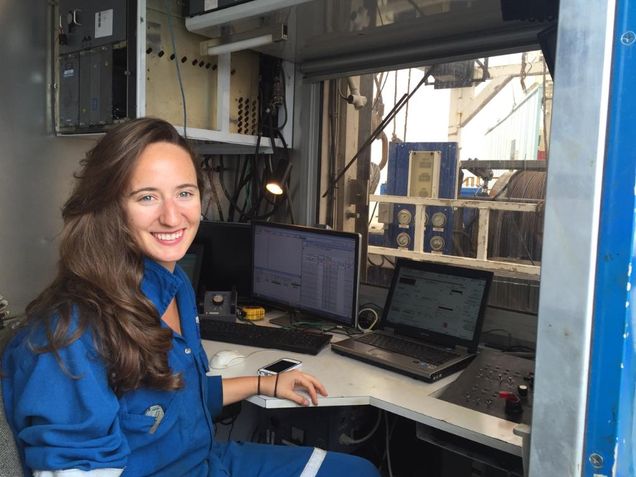
Sonja Page ’09
 Sonja Page ‘09 graduated from the University of Rochester with her B.S. in Biomedical Engineering and Minors in Chemical Engineering and Business in 2013. She worked at Schlumberger, the world’s leading oilfield services company, as a Senior Field Engineer. Sonja is currently an MBA student at Harvard Business School exploring entrepreneurship and full-time roles combining business and engineering in technology companies. In her free time, Sonja enjoys mountaineering, hot yoga with friends, and skiing.
Working in the California oilfields can be challenging and pressure-filled. What were you responsible for as a Senior Field Engineer? What skills and abilities do you hope to bring forward from this experience?
As a field engineer, I managed a crew of two to three operators, and used tools with sophisticated sensors to evaluate different aspects of an oil well (formation pressure, oil location, oil volume, cement quality, etc.). I also perforated wells using perforating guns. Detonating perforation guns creates multiple holes in the well casing and formation that allows oil to be extracted from the well. In order to complete these tasks, I got my Commercial Truck Driver’s License, Crane Operator’s License, and Blaster’s License in the state of California.
Do you have any advice for women looking to enter the historically male-dominated oil and gas industry?
- Find allies in your organization. My allies were my operators and some of my fellow engineers. I always made sure to have my operators’ backs, and they made sure to stick up for me when necessary. My operators had been working in the California oilfields much longer than I had. They were especially helpful when I first went offshore. They made sure to tell me important information, introduced me to everyone, and encouraged me to ask a lot of questions. Looking back, my job would have been a lot more challenging without them.
-
Be very clear about your performance goals with your manager. Early on, I established myself as a hard worker, but also made my goals and ambitions for a fast promotion schedule clear to my manager (typically engineers are promoted every two years). I created a timeline for my ideal promotion schedule (including performance goals to meet), and shared it with my manager. We agreed on the necessary performance required to move forward with each promotion. As I accomplished more in the field, but did not see progress with my job status and responsibilities, I referred back to the timeline with my manager, to show the deviation from the mutually-agreed-upon timeline. This helped me stay on track with my goals and stand out as a top performer.
What was your BUA thesis about and how did you decide on that topic?
I conducted research at the Mohanty Nanotechnology Lab, and wrote my thesis on reversible logic gates. I originally wanted to do research on dinosaurs, but funding at a Harvard lab fell through, and I was unable to do that project. I had a strong interest in a science topic, and felt that Professors Mohanty and Matthias (the post-doc I primarily worked with) would be great mentors for the project.
My advice to current students on thesis topics:
- Don’t be afraid to explore. You should attend talks on subjects that interest you to help find a great topic.
- Ask a lot of questions and find mentors (professors or graduate students in labs) who you can learn from.
How did your BUA education help you in college or in your career thus far?
I commuted into BUA from the North Shore every day. My commute was 1.5 hours each way (on a good day!), and provided me with a lot of discipline and responsibility. I learned how to manage my time, and to balance a significant workload while also making time for friends, sports, and occasional relaxing. As my life has become more complicated and busy, I have used this discipline to continue to manage my life.
Survey Highlights: A Portrait of BU Academy As Drawn By Its Community
A culture of inquiry. Rigorous examination. Honesty and integrity. These core values of Boston University Academy inspired us to conduct a frank, independent, and comprehensive analysis of BUA itself. In 2016, we engaged a respected research firm to find out how we’re doing.
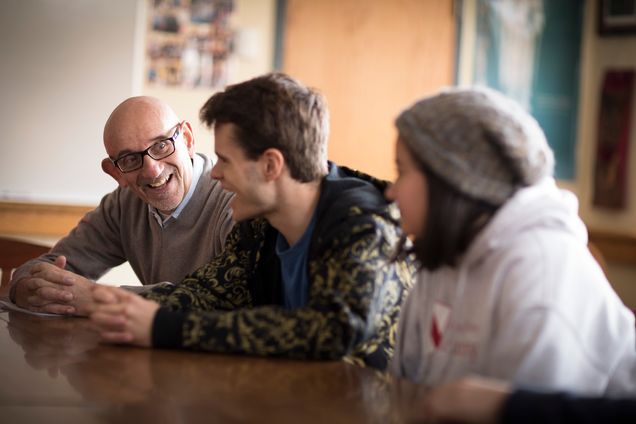
BUA Announces Great Teachers Fund for Academic Enhancement
We are delighted to announce the establishment of the Boston University Academy Great Teachers Fund for Academic Enhancement. A generous gift in the amount of $100,000 from Boston University Trustee Ruth A. Moorman (CAS ’88, SED ’89, SED ’09, P BUA ’15) and Sheldon N. Simon (P BUA ’15), parents of Sarah Simon ’15, will establish the permanently endowed fund in celebration and commemoration of Boston University Academy’s 25th anniversary year.
The Fund will support BUA initiatives while honoring the school’s retiring master teachers. Gifts to the Fund will benefit BUA students, teachers, and the school as a whole by helping to incorporate unique learning opportunities that lift the quality of teaching inside and outside the classroom.
2017-2018 Challenge: The Moorman-Simon Family is offering their $100,000 gift as a challenge to the BUA community, with the goal of raising at least an additional $100,000 from current parents, parents of graduates, alumni, faculty, staff, and friends. Please consider making a gift today!
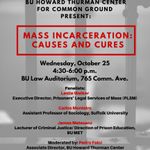
All-School Learning Experience Community Panel: “Mass Incarceration: Causes and Cures”
Join Boston University Academy and BU Howard Thurman Center for a co-sponsored panel discussion entitled "Mass Incarceration: Causes and Cures."