News
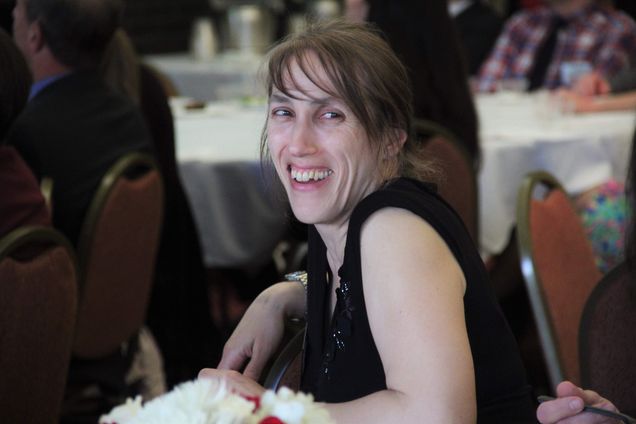
Remembering Dr. Jennifer Formichelli
Boston University Academy English teacher Dr. Jennifer Formichelli passed away in a tragic accident near her home in Mattapan on the morning of October 26. She touched so many lives in our school community, and her loss is profoundly felt.
Jennifer will be remembered as a thoughtful, highly intellectual scholar of English literature; a champion of social justice, deeply committed to equity and inclusion in and out of the classroom; a trusted advisor; a warm and loyal colleague and friend; and, most of all, an engaged and dedicated teacher who loved her students. Through her work at BU Academy, she shaped the lives of hundreds of young people. She was a cherished member of our school community and will be deeply missed.
BU Today published this moving remembrance of Jennifer Formichelli on the day of her passing. A candlelight vigil for Jennifer Formichelli will be held on Thursday, October 28 at 5:30 p.m. on Marsh Plaza.
Community members are invited to share their own remembrances or tributes to Dr. Formichelli on this webpage, or by mail at 1 University Road, Boston MA 02215.
HOS Blog: Homer with a Side of Humor
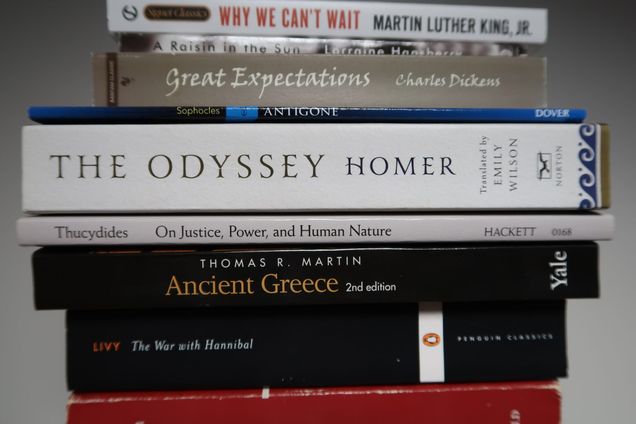
I visited a ninth-grade English class yesterday. The group was discussing an early passage in Homer’s Odyssey where Telemachus, Odysseus’s son, was expressing frustration about the bad behavior of the suitors, who were vying for his mother’s hand in his father’s long absence during his return from Troy and shamefully taking advantage of the hospitality of the household. One of the students offered, with a wry smile, “Telemachus could just do what Oedipus did and marry his mother — that would solve everything!” The teacher replied, with a wink, “And how did that work out for Oedipus?” The class had a good laugh and went right back to the task at hand.
Humor in the classroom does more than lighten the mood. It creates an emotional bond between teachers and students, and an atmosphere of emotional safety that is critical to learning. We know from decades of research that teaching and learning is fundamentally relational; students learn best when they know that their teacher knows and cares about them. A classroom where it is safe, even encouraged to make a joke, be vulnerable, and laugh together — that is a place where the door to learning is wide open.

HOS Blog: Inclusion in Five Languages
Last year, several students teamed up with our admission officers to record video information sessions for prospective students and families — not an unusual move, particularly when the pandemic made campus visits complicated. The wrinkle? They recorded those sessions in Portuguese, Spanish, Russian, and Mandarin Chinese — four languages commonly spoken in our students’ homes.
Inclusion requires action. It is necessary, but not enough to be kind, polite, and friendly. In making our admissions information sessions available in multiple languages, these students understood that, particularly for the families of our first-generation American students, we could remove a barrier and meet them where they are.
We work hard to actively create an inclusive community across the school: a holistic financial aid program that covers not just tuition but so many of the incidental expenses that pose challenges to full community engagement; affinity spaces for students and alums who identify as people of color to be together and share their experiences; a Gay-Straight Alliance serving both as an informal affinity space and one that generates ideas for community education; parent and student cultural celebrations where they can share their stories and experiences; a seminar for all 9th and 10th graders where we talk directly about about identity, bias, privilege, and action.And we have more to do. Inclusion is a core value at BUA, and I’m proud that no matter what structures we put in place, the focus shifts to what else we can do to make sure that this place feels like home for any student or parent who walks through our doors — or joins us by video.

HOS Blog: Columbus Day and American Mythology
I taught American history for many years, and every fall at about this time we would have a debate in class about whether we should continue celebrating Columbus Day or rename that holiday in some way (I assured students that either way there would still be a day off from school — anticipating their most pressing question!). In preparation, students would read about Columbus — including a chapter from Howard Zinn’s The People’s History of the United States.
They were surprised, sometimes upset to learn that the story of Columbus — the one that we adults grew up with — is at best incomplete, and in several important ways inaccurate. Columbus set off to find a route to Asia, but instead accidentally “discovered” several locations in the Caribbean and the Gulf of Mexico (not the present-day United States), many of which were already populated by native peoples. Columbus and his men — in pursuit of gold and profit — committed a range of atrocities, enslaved the native peoples, and brought disease that decimated those populations. The debates often ended with students proposing that the day be reframed both to remember this dark chapter in history and celebrate the cultures of indigenous people.
This year, BUA joined the broader university, many of our peer schools, and several Massachusetts cities and towns in commemorating Indigenous Peoples Day.
America, like all cultures, has a mythology. In 1934, when FDR designated Columbus Day as a national holiday, Columbus was chosen to represent certain values — ways we like to think of ourselves as Americans: bold, innovative, enterprising, and independent. While those traits are only one part of Columbus’s story, they served a purpose in our founding mythology. Columbus became part of our narrative. In the best BUA tradition, this year students are exploring and reframing the narratives in our history, beginning junior year American history, for example, with Daniel Richter’s Facing East from Indian Country: A Native History of Early America. Unpacking our national history and our mythology is a requirement of good citizenship; helping students do that is one of our sacred responsibilities.

61% of BUA Senior Class Receives National Merit Recognition
An impressive sixty-one percent of the Boston University Academy Class of 2022 received recognition in the 67th annual National Merit Scholarship Program competition.
Twenty current BUA seniors were named National Merit Commended Scholars. They are among the roughly 34,000 U.S. seniors recognized for "exceptional academic promise," and place among the top 50,000 students who entered the competition by taking the 2020 Preliminary SAT/National Merit Scholarship Qualifying Test (PSAT/NMSQT).
Out of these 20 Commended Scholars, five BUA seniors were named National Merit Semifinalists, placing them among the top 1% of all US high school seniors who entered the competition. Semifinalists will have the opportunity to continue in the competition for some 7,600 National Merit Scholarships worth more than $30 million. National Merit Scholar finalists will be announced on February 7, 2022.
Three members of the BUA Class of 2022 received a total of four College Board National Recognition Program honors by scoring in the top 2.5% of PSAT/NMSQT test takers who identify as African American, Hispanic American, Latinx, or Indigenous. Two current seniors were named National Hispanic Recognition Scholars; one senior was named a National African-American Recognition Scholar; and one senior received both honors. 32,000 students across all 50 states were recognized for "excelling in their classrooms and on College Board assessments."
Congratulations to all of BUA’s honorees on this well-deserved recognition!

HOS Blog: The “I’m Just Not Good at Art” Fallacy
“I’m just not good at art.” How many of us have said, thought, or heard that at some point in our lives?
Earlier this week, I had the pleasure of visiting three art classes. I watched students in first-year visual art working on contour drawings of simple objects stacked on their tables. A dozen ninth graders in introductory drama each performed simple movements of their choice, which their classmates analyzed using the Laban Principles of movement. And the Jazz Band worked on one of its first pieces of the year, “Duke’s Place,” where each member took a turn to solo; those solos ranged from one-note experiments to virtuosity, but they were all done with gusto!
Particularly in art, but also in math and athletics, we sometimes fall into a trap: assuming that either you have it or you don’t. The art classes I visited embraced the opposite (and accurate) philosophy: while we start in different places, skill in the arts comes from practice and study.
Stanford researcher Carol Dweck explored this idea in her book Mindset. She described two viewpoints. Somebody with a fixed mindset tends to assume that skills, habits, and aptitude — like intelligence or artistic ability — are innate and immutable. Those with a growth mindset believe that those things can be developed over time. The fascinating central insight in Dweck’s work is that, controlling for other factors, one’s mindset actually impacts performance. If you think academic ability, for example, is innate, a low grade means that you are in some way deficient; it exposes you, leads to insecurity, and often discourages effort. Having a growth mindset makes it more likely that you will learn from a setback, hear feedback, stay motivated, and keep learning. That is what we want for our students, and that is the attitude we try to foster in the arts and all around campus.
Dr. Monica Alvarez: “Voice and Belonging”
On Tuesday, September 28, BUA English Teacher Dr. Monica Alvarez presented a talk at All-School Meeting entitled "Voice and Belonging." In her remarks, Dr. Alvarez shared personal reflections of growing up with a stutter, how she overcame her speech impediment -- in two languages! -- and how she pushed through her fear to finally find her voice.
Watch Dr. Alvarez's complete talk here:
HOS Blog: Let’s Focus on Student Engagement, not Participation
It’s time to rethink the student participation grade.
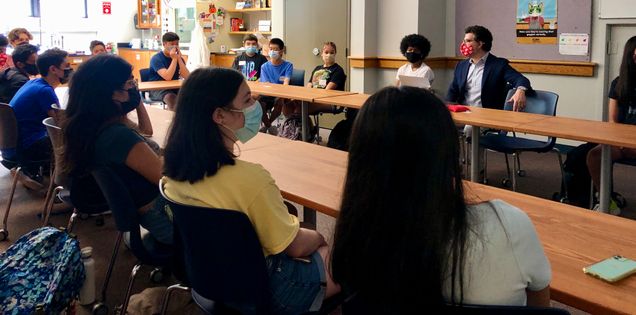
Every three weeks, our teachers gather after classes for professional learning meetings — a chance for us to share ideas, learn from one another, and improve our practice, all in the interest of serving our students better. The topic for this week’s meeting was student participation. What is our expectation for how students participate in class? How do we communicate that expectation? How do we assess participation?
The biggest takeaway was a consensus around the following reframing: Let’s stop talking about student participation and instead encourage student engagement. It’s a shift that many of our teachers have already made, and for good reason.
As adults, we have all been in meetings where somebody monopolizes the conversation without moving the group forward; in fact, that behavior can often detract from the enterprise. Encouraging and grading “participation” can, inadvertently, create incentives for students to do just that and learn the wrong lesson. “Participation” grades can also give the false impression that a student who is listening carefully and offers perhaps one thoughtful comment is not “participating” meaningfully. We know from our adult experience that the opposite is often true; many of the most effective voices are those that listen first and speak infrequently. When they do speak up, others take note.
What we care about — and should measure — is not the number of times a student raises a hand in class. We care about their engagement: a great post to an online discussion board; outside research diving deeper into the content; meeting with the teacher during a free period; helping out a friend with homework; partnering well on group projects; and, yes, making meaningful comments in a class discussion that move the group forward. The remote-learning world spurred by the pandemic taught us all that there are many ways for students to engage. Some students who are quiet in traditional classroom settings found ways to thrive and shape the conversation on Zoom chat and message boards. We need to pay attention to that. And we need to encourage what we value most.
HOS Blog: Greeting Students at the Door
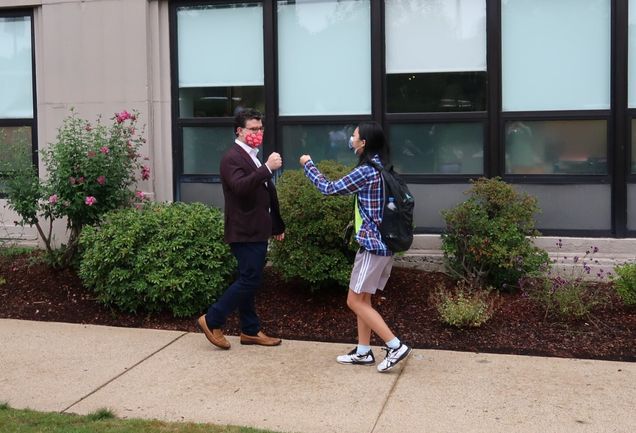
I begin most days standing outside the front doors of the schoolhouse greeting students. Some are just getting off the train, some emerging from their parents’ cars, others hopping off bikes or skateboards. Everybody gets a “good morning,” and sometimes students pause for a little conversation — a chance for a student to tell me about a lab they did in chemistry the day before or for me to pat them on the back for some good hustle in the soccer game. Last week, one ninth grader looked at me and asked, “Did I do something wrong? Did I miss something? Why are you out here?” I smiled and assured him that everything was fine and that I greet students just to be friendly.
His question did make me think, though, about the purpose behind the ritual. The truth is that I’ve seen others do it and have adopted it just because it feels right. But I suspect there’s more to it. The transition from home to commute to school can be complicated and sometimes stressful for these young people. Maybe a smile given and returned can make that a little easier — relieving the stress, momentarily, around the geometry test coming up later in the morning. It’s also a moment for every kid to feel seen. Inclusion sits at the heart of our mission; every student deserves to feel like this place is home no matter where they come from. If a welcome at the start of the day can help do that, even for some, then it’s time very well spent. Plus, I learn a lot about what’s happening in these kids’ lives in the process and, selfishly, it’s a fun way to start the day.
I’ve since discovered that there is quite a bit of writing and even some scholarly research indicating psychological and pedagogical benefits of greeting students at the door in the morning. But even without the research, I’m going to keep doing it because it fits with who we are.
See you in the morning.
Leaving Things Better than You Found Them (or The Grace in Picking Up Somebody Else’s Trash)
All-School Meeting Remarks on September 9, 2021
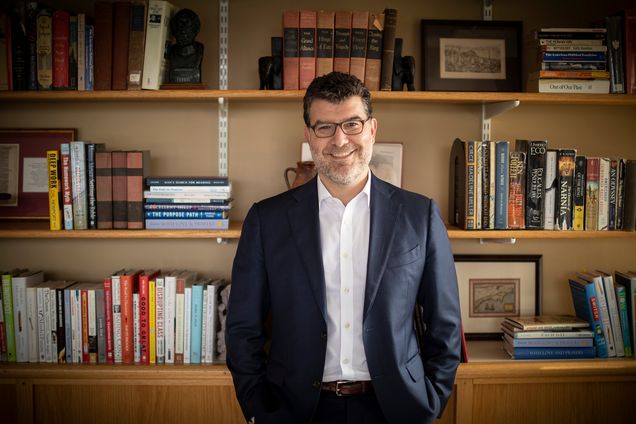
Chris Kolovos, Head of School
Good morning. I find myself deeply moved at the sight of us gathered as a community like this. It feels like the first spring day after a winter that lasted far too long.
All-School Meeting is a sacred time for me. It is a physical manifestation of -- in the language of our mission -- “our caring high-school community.” These meetings are a chance for us to share, celebrate, and laugh together in good times, to mourn and comfort one another in hard times. It is especially fitting that we gather in this space, which for its first sixty years served as Temple Israel.
Today, we’ll start a tradition where I address the school at the start of each academic term. I hope to offer thoughts beyond the day-to-day.
That tradition comes from my upbringing. When I was a boy, my head of school gave talks like this several times a year. They were solemn occasions, often involving singing in Latin (which I loved), and were somewhat risky; chair seats were sloped backward at the perfect angle for coins to roll onto the floor and echo through the chamber. That noise would be greeted by a steely gaze from our head of school, Mr. Jarvis.
I’d like for you to know a little bit about him. Mr. Jarvis passed away a few years ago. Aside from my parents, he was the person who had the biggest influence on me and, in many ways, is why I am doing what I am doing today.
He was tough. Picture an Episcopal priest in a dark suit, collar, an impeccable part in his hair, and perfect creases in his pants. I vividly remember being called into his office after penning an editorial for the school newspaper criticizing the choice of outside assembly speakers. He opened with “You’ve embarrassed yourself and all of us.” When I accepted a prize from him on Prize Day, but had failed to button my top button and cinch up my necktie, he pulled me close and whispered in my ear: “Don’t ever do that again.”
And he loved us. He would grab us firmly by the arm in the hallway, look us straight in the eye and say, almost accusatorily, “You know that I love you.” He was talking about what the Greeks called agape: unconditional love with no expectation or desire for anything in return. As intimidated as many of us were of him, we knew he loved us. That was unshakable, even if he did sometimes admit, with a glimmer in his eye, “We love you. We just don’t like you very much right now.”
The messages he shared with us in assembly twice per year felt important and often heavy. Many of those talks are collected in a book I keep close by: With Love and Prayers. In one talk, he offered the following: “Let me, then, summarize the bad news: you are not perfect just the way you are and the world was not created to satisfy your every need and desire.” In another: “Try to imagine yourself at your own funeral.” At 7:30 in the morning before a Geometry test, that felt like a lot.
But his words stuck with me. The messages he shared and the example he set have shaped so much of my life. He never once talked down to us. Instead, he addressed the most important questions. Why are we here? What is expected of us as members of our community and our world? What does it mean to live a good life?
I am not him. I will not try to mimic his mannerisms or mold our time together to match the culture he created. But I feel the responsibility to ask those same questions with all of you in a way that is authentic to me and to this culture. I know you are thinking about these fundamental questions already and deserve the chance to process them as a group.
My talk today is about leaving things better than you found them. If you are looking for a more pithy subtitle -- the dessert that writers treat themselves to -- I’d suggest “The Grace in Picking up Other People’s Trash.”
I mean that in a literal way. I was in the schoolhouse late Friday evening and walked through the student common spaces. They were shockingly neat! I’m not entirely sure how a playing card found its way behind the copier, but that mystery aside, I was impressed with the state of things. I know the excellent BU cleaning crew was not the reason, since they come very late in the night. The reason is that some of you are not only picking up after yourselves but leaving those spaces better than you found them. I’m reminded of the student last week who found me outside the gym and asked, somewhat mysteriously, where he could find a broom. In no time, he and I and some of his classmates were cleaning up a small mess that somebody had left on the gym floor. That attitude is the opposite of the that’s-not-mine attitude you sometimes hear. There is grace in picking up somebody else’s trash.
That habit carries over in a less literal way. Think about the hundreds of little interactions you have over the course of a school day -- with classmates, teachers, staff at the GSU, riders on public transportation, and family members. Approaching those interactions with kindness, empathy, and generosity leaves the people around you better than you found them. I was struck last fall watching a group of 10th graders walking the halls introducing themselves to new 9th graders because those sophomores remembered what it was like to be new. If you see somebody eating lunch alone, say hi. Hold the door for somebody behind you, even if you’re running late. And when we have visitors on campus, take a moment to introduce yourself and help them find their way -- even if that means being late to class. There is grace in those small kindnesses
At the end of each day, when you lay your head down on the pillow, I encourage you to ask yourself this question: Did you leave anything -- or anyone -- better off today?
Taking a longer view, another question: When you walk across the stage at graduation, how will you have made this school and your communities better? What will your legacy be?
A few days ago, I met with two students who have a passion for sustainability and are preparing a grant application to improve an overgrown outdoor space between the school’s parking lot and the gym. They hope to clear and terrace the space, adding native plantings for pollinators and to filter the water before it finds its way into the groundwater table and the river. They are not alone. The Student Council has done wonderful work strengthening this community, including an initiative to make textbooks more accessible. Students are part of our diversity, equity and inclusion committee, engage in regular service work in Boston and other neighborhoods, taught Boston middle schoolers in video game design camp this summer, and do so much more.
Schools and adults sometimes make the mistake of thinking that we are preparing students to make an impact later. That’s wrong, or at least incomplete. You students are capable of making positive change today. I know that because I see it all around me.
There is one other moment I’d like you to consider. I took one of Mr. Jarvis’s quotes out of context earlier. Here is the full paragraph: “Try to imagine yourself at your own funeral. What is it that you want people to say about you? That’s the question you have to answer if you want to find a long-range vision for your life.”
A few years ago, I got a call from a student I taught early in my career. After high school, he attended a highly selective, prestigious college. After that, he attended an equally famous graduate program and was working at one of the top consulting firms in the world, making a healthy salary. He shared with me that despite having achieved all those things, he was unhappy -- and he did not know why.
He made the mistake that I made at around his age. We both assumed that achieving “success” -- prestigious schools, lucrative jobs in high-status careers -- would automatically bring happiness and fulfillment.
We know a great deal about the things that contribute to a happy, fulfilling life. I return often to Viktor Frankl’s Man’s Search for Meaning and the literature that work has spawned. The central insight is that purpose -- not status, wealth, or even passion -- is the key factor in a happy life. And we find purpose most often in relation to others.
Mr. Jarvis, who was a man of the cloth, told this story: “I visit several older people on a regular basis as part of my duties as a clergyman. They are people for whom the prospect of death has now become real -- as it will for us someday. I’ve noticed that when these people reminisce about their lives, they rarely brag about making a lot of money or achieving some high position. If they speak with pride or with joy about their lives, it is almost always to talk about something they did for someone else.”
We talk a great deal, perhaps too much, about you students finding your passion. It is helpful to think about areas that you find interesting. The key, though, is finding where that passion intersects with others; where you can use your gifts, follow your heart, and make an impact. The education you receive here gives you that option.
What do you want people to say about you when you are no longer here?
At this point you may be wondering, “How did we get from picking up trash in the common room to a life vision and a happy death?”
Small actions become habits. Habits take hold and become character. You begin to identify yourself as a person for others and take pride in that identity. In the process, you’ll not only make your communities better but, in so doing, find deep, personal fulfillment.
I’ve spoken to nearly all of your families and can say for certain that what they want most for you is what we want as well: that you are happy and fulfilled in your lives, now and in the future. You’ve often heard me recite the biblical phrase: “From those to whom much is given, much is expected.” We expect a great deal from you because you are supremely capable. But it is also because reaching for those high expectations is precisely what will lead you on that path to fulfillment and joy.
Thank you, and I wish us all a wonderful year together.